
Machined parts ship within 7-15 days. Order your metal machined parts today!


-
-
-
-
Blog Explore our facilities, technology, processes, and more.

-
Products Rigorous quality management processes ensure part consistency.
-
Quality Assurance See how companies used 3ERP services to solve challenges and speed up development.
-
Materials Browse a variety of metal materials to meet your project needs.
-
Manufacturing Guides Explore various manufacturing guidelines and reports.
Resources
-


Adjustable Aluminum Bike Stem Riser for Mountain Bike | MTB Handlebar Stem OEM
|
Project |
Parameter |
|
Processing Type |
Precision forging+CNC machining |
|
Design Support |
2D/3D Drawing review,Prototype Development,OEM,ODM |
|
Material Capability |
Aluminum alloy, copper, steel, copper alloy |
|
Machining Accuracy |
±0.02mm |
|
Forging Accuracy |
±10mm |
|
Common Materials |
2014, 6061, 6063, 6082,7075, 7050, C1100, C1020 etc |
|
Quality Control |
Incoming Material, In-process, final inspection,IATF 16949 Certified,ISO 9001 Certified |
|
Surface Treatment |
Anodizing, sandblasting, polishing, electroplating, powder coating, blackening |
|
Manufacturing Process |
forging,T4 / T6 Heat Treatment,CNC machining, drilling, tapping, deburring, surface treatment,Packaging |
|
Processing Equipment |
forging equipment , Turn-Mill Machines, CNC lathes |
|
Testing Equipment |
Three coordinate inspection, NDT,hardness inspection, size inspection, Tensile Strength Testing, appearance inspection |
|
Service Content |
forging machining,Precision CNC Machining, surface treatment,OEM,ODM |
- Product Description
- Attributes
-
The Mountain Bike Adjustable Stem Handlebar Riser is a precision-engineered cockpit upgrade designed to improve rider fit, handlebar positioning, and front-end control across a wide range of mountain biking applications. Built around a robust adjustable-angle design, this component allows riders to fine-tune stem height and reach according to terrain, riding style, and personal ergonomics. Whether the goal is to reduce strain on the back and shoulders, raise the handlebar for a more upright riding position, or improve steering leverage on technical trails, this adjustable stem provides a practical and highly adaptable solution.
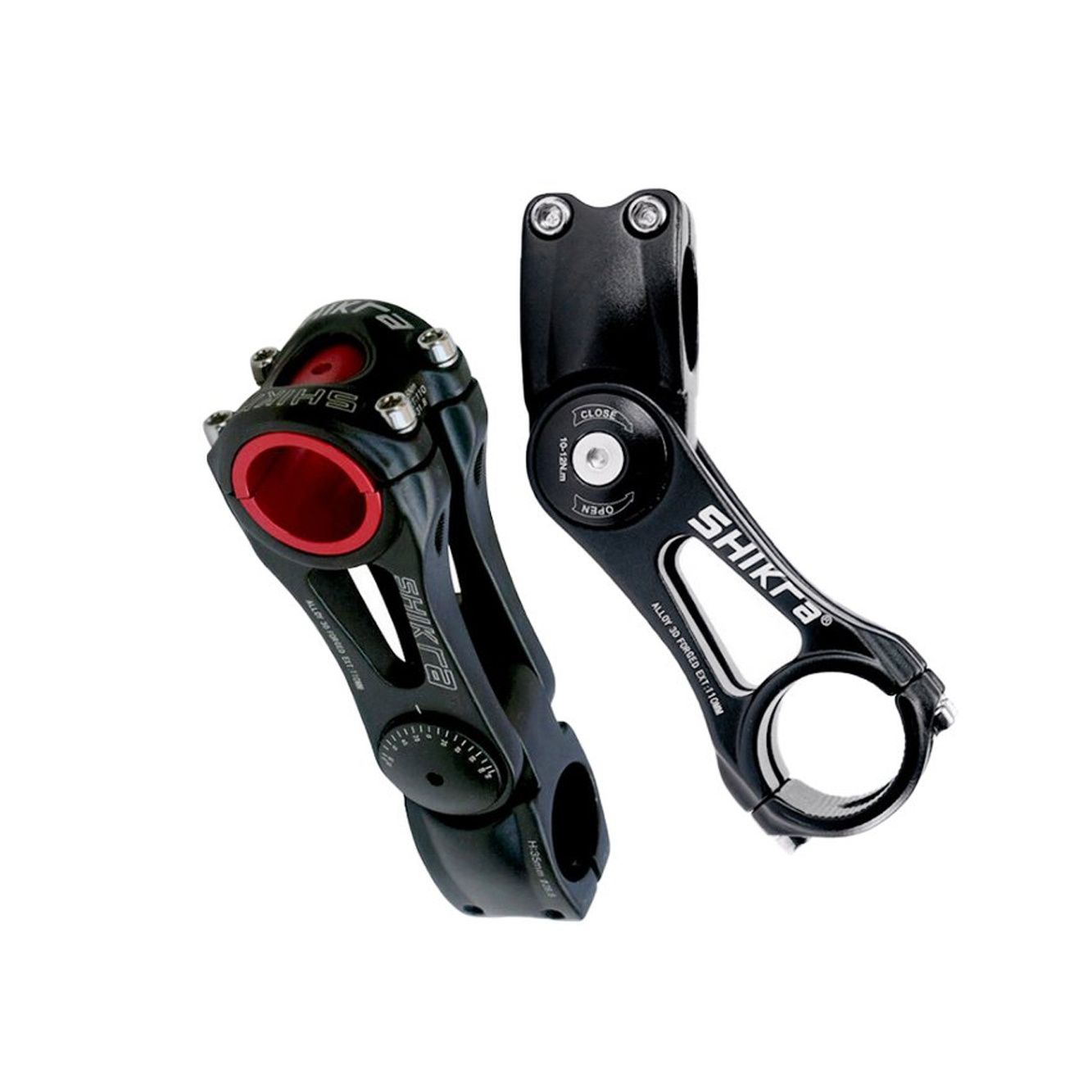
As shown in the product image, the stem features a compact, aggressively styled forged or CNC-machined alloy body with a black anodized finish and contrasting metallic red detail rings. The visible clamping hardware and dual-bolt structure reflect a design focused on secure fastening, repeatable adjustment, and reliable performance under off-road loads. The overall appearance is sporty, technical, and purpose-built for modern mountain bike systems. Beyond aesthetics, the real value of this component lies in its ability to change the rider-bike relationship without requiring a full cockpit replacement.
Product Overview
A mountain bike stem is more than a simple connector between the fork steerer and handlebar. It is one of the most influential parts of the cockpit because it directly affects steering response, body posture, braking stability, climbing comfort, and descending confidence. An adjustable stem improves this function further by introducing a controlled angle adjustment mechanism, allowing the handlebar to be positioned higher or lower depending on riding requirements.
This type of stem riser is especially useful for riders who:
- want a more upright and relaxed riding posture,
- experience neck, wrist, or lower-back fatigue on long rides,
- switch frequently between climbing, trail riding, and commuting,
- need a more comfortable setup for endurance riding,
- are testing cockpit geometry before committing to a fixed stem length or rise,
- prefer a versatile cockpit that can be tuned seasonally or terrain-specifically.
The stem shown in the image appears to be designed with careful attention to structural integrity and usability. The large clamping interfaces, reinforced arm profile, and adjustment pivot suggest a product intended for serious trail use rather than casual recreational riding. It is the kind of component that can subtly transform the feel of a bicycle without altering the frame itself.
Visual Design and Construction Details
The product image reveals a stem with a distinctly modern, performance-oriented design language. Its black finish gives it a stealthy, premium appearance, while the red internal ring adds contrast and visual depth. The machined edges, radial adjustment markings, and exposed hardware all emphasize the mechanical nature of the component.
Notable visible design characteristics
Visual Element Observed Feature Functional Benefit Main body Compact alloy structure Supports strength while minimizing excess bulk Finish Black anodized appearance Improves corrosion resistance and gives a clean, premium look Accent ring Red anodized internal ring Adds visual contrast and highlights the adjustment zone Adjustment joint Central pivot with degree markings Enables controlled angle changes and repeatable setup Handlebar clamp Oversized circular clamp area Helps secure the bar with reliable grip and stability Steerer interface Two-bolt style top clamp Promotes even loading and secure attachment Arm profile Hollowed structural design Reduces weight while maintaining rigidity The styling communicates engineering confidence. Rather than hiding the mechanics, the product showcases them: bolts, pivot points, and alignment marks are all visible and integrated into the visual identity. That is often a hallmark of high-performance bicycle components, where form and function are closely aligned.
Engineering Purpose
The primary function of an adjustable stem riser is to modify cockpit height and reach geometry. In practical terms, this means the rider can raise the handlebar position to create a more comfortable spinal angle, reduce pressure on the hands, and improve visibility on rough or steep terrain. At the same time, the stem can be adjusted downward when a lower, more aggressive body position is desired for speed, climbing efficiency, or direct steering feedback.
This adjustability is particularly beneficial in mountain biking, where trail conditions can vary dramatically. A steep climb may benefit from a slightly higher bar and more relaxed torso posture, while a fast descent may benefit from a lower center of gravity and more direct front-end feel. With a traditional fixed stem, these changes require replacement parts. With an adjustable stem, the bike can be tuned in a matter of minutes.
The engineering challenge is to provide this flexibility without compromising stiffness or safety. For that reason, a product like this typically uses high-strength aluminum construction and carefully designed pivot hardware. The clamping zones must resist twisting under hard braking and aggressive steering inputs, while the angle adjustment mechanism must remain secure under vibration, impact, and repeated load cycles.
Why an Adjustable Stem Matters on a Mountain Bike
Mountain biking places unique demands on the front end of the bike. The rider must simultaneously manage traction, steering precision, shock absorption, and body positioning. Even a small change in stem angle or height can significantly alter how a bike feels on trail.
Key riding benefits
1. Improved comfort on long rides
A higher handlebar position can reduce excessive forward lean, which may help alleviate pressure on the lower back, neck, and wrists. This is especially valuable on long-distance trail rides, endurance events, and all-day mountain adventures.2. Better climbing posture
When climbing steep grades, riders often want to remain seated while keeping the front wheel planted. A handlebar that is too low may force an overly aggressive torso angle. Raising the stem can improve balance and reduce fatigue during sustained ascents.3. Tunable descending confidence
For descents, many riders prefer a slightly lower and longer cockpit feel. An adjustable stem allows experimentation with geometry until the ideal balance between control and agility is achieved.4. Rider-fit customization
Not every rider shares the same torso length, arm length, shoulder mobility, or riding preference. This product supports personalized setup without needing a new frame or fork.5. Practical versatility
A single stem can serve multiple use cases: trail riding, XC riding, commuting, fitness riding, and mixed-surface use. It is a useful solution for riders who want one bike to do more than one job.Material and Structural Considerations
Although exact alloy specifications are not stated in the image alone, the product clearly presents itself as an aluminum alloy component with a machined and anodized surface finish. In this category, aluminum is widely favored because it offers an excellent balance of strength, weight, machinability, and corrosion resistance.
Typical advantages of alloy stem construction
- Lightweight performance: helps reduce front-end mass without sacrificing essential stiffness.
- Corrosion resistance: anodized finishes help protect against moisture, sweat, mud, and trail grime.
- Structural reliability: a properly engineered alloy stem can withstand repetitive cycling loads.
- CNC-friendly precision: sharp edges, consistent clamping geometry, and fine adjustment markings are easier to execute in metal than in many polymer or composite alternatives.
- Professional appearance: machined surfaces and anodized finishes are common in higher-end mountain bike components.
The hollow or cut-out arm profile visible in the image is especially important. Structural windows and relief cuts are often used to remove unnecessary material while retaining load-bearing shape. This is not just cosmetic: it is part of a broader design approach aimed at keeping the stem strong, rigid, and efficient.
Handlebar and Steerer Interface
A stem is only as good as its interfaces. The handlebar clamp and steerer clamp must both perform flawlessly under dynamic riding conditions. Based on the image, this stem appears to use a robust split-clamp or face-clamp style at the bar end and a secure multi-bolt interface at the steerer side. The overall design suggests an emphasis on secure torque retention and even force distribution.
Why the interface design matters
- Reduces slippage: secure clamping prevents unwanted handlebar rotation.
- Protects components: even clamping pressure lowers the risk of over-stressing the bar or steerer tube.
- Improves steering precision: a stable interface reduces flex and lag in steering response.
- Supports repeated adjustment: a well-made clamp system can be loosened and retightened without rapid wear.
The adjustment joint on the stem arm appears to include degree markings or indexed reference points, which is a useful feature for setup consistency. Riders can note their preferred angle and return to it after travel, maintenance, or component changes.
Performance Positioning
This adjustable stem riser is best understood as a cockpit tuning tool. It is not simply about making the handlebars “higher.” It is about changing the rider’s relationship to the bicycle in a controlled, measurable way.
How adjustment influences ride feel
Adjustment Direction Ride Effect Typical Use Case Higher handlebar position More upright posture, reduced reach Comfort riding, climbing, trail endurance Lower handlebar position More aggressive stance, more front-wheel weighting Descending, XC performance, faster cornering More upright angle Easier weight transfer rearward Technical climbs, comfort-focused riding Flatter angle More direct steering feel Speed, stability, responsive handling Because the exact handlebar height and stem angle can be changed, riders may fine-tune the bike for different body positions and route profiles. That makes this component especially attractive to riders who ride a variety of trails or who are still dialing in their ideal fit.
Ideal Use Cases
This product is suitable for a broad set of riders and bike setups, provided compatibility requirements are met.
Common applications
- cross-country mountain bikes,
- trail bikes,
- recreational MTB builds,
- city bikes with off-road capability,
- commuting bikes where comfort is a priority,
- bikes used by riders recovering from wrist or back discomfort,
- youth or entry-level bikes that need a more forgiving cockpit,
- bikes undergoing fit optimization after a frame size change.
The adjustable stem can be especially useful on bikes where the frame geometry is otherwise fixed. Instead of changing the whole bike, the rider can adjust a single cockpit component to achieve a more appropriate fit.
Installation and Setup Advantages
One of the most important advantages of an adjustable stem is the ease of setup. Compared with replacing spacers, changing fork steerer height, or swapping to multiple fixed-angle stems during a test period, an adjustable design offers a straightforward path to iterative fitting.
General setup benefits
- easier to test multiple positions,
- quick geometry tuning without permanent modification,
- useful for bike fitting and posture experiments,
- convenient for riders who share a bike,
- helpful for comparing comfort versus performance settings.
For best results, installation should always be performed carefully using the correct torque values, proper grease or carbon paste where appropriate, and a professional-grade hex tool. Final setup should be checked after initial rides to confirm that all bolts remain secure and that the clamp surfaces are seating properly.
Professional Product Description
The Mountain Bike Adjustable Stem Handlebar Riser is a highly functional cockpit upgrade engineered to improve both riding comfort and front-end adjustability. Designed with a sturdy alloy structure and a refined mechanical pivot, it enables riders to alter handlebar height and stem angle in a controlled, repeatable manner. The result is a more adaptable bike that can be tuned for climbing efficiency, descending control, urban comfort, or long-distance endurance.
Its compact construction and precision-machined appearance reflect a product built for performance-oriented riders. The anodized black finish delivers a clean, premium look while helping resist corrosion from moisture, mud, and routine trail exposure. Red accent details highlight the adjustment zone and add a purposeful, technical visual identity. The oversized handlebar clamp and secure steerer interface reinforce the impression of a stem designed to prioritize stability and safety under demanding riding conditions.
For riders seeking a more upright posture, this adjustable stem can help reduce upper-body strain by raising the cockpit position. For those wanting more responsive handling and a lower front end, it can be dialed back to a more aggressive angle. This flexibility makes it especially valuable on mountain bikes, where route profiles and rider preferences can vary widely from one ride to the next.
Whether used for recreational trail riding, bike fit refinement, or practical comfort improvement, this adjustable stem handlebar riser offers a robust and versatile solution. It is a product that combines the precision of engineering hardware with the everyday utility of riding ergonomics, making it an ideal choice for riders who want better control over how their bike feels on the trail.
Feature Summary Core advantages at a glance
Category Description Product type Adjustable mountain bike stem / handlebar riser Primary function Raises or lowers handlebar position through angle adjustment Material style Alloy construction with anodized finish Design style Compact, technical, performance-oriented Finish Black with red accent detail Adjustment Angle-tunable pivot mechanism Intended use MTB, trail, comfort tuning, cockpit fit Key benefit Better ergonomics and more adaptable handling Technical Selling Points
- Adjustable angle for personalized cockpit geometry
- Strong alloy body suited to off-road use
- Precision-machined appearance with premium finish
- Secure clamp architecture for stable steering input
- Useful for riders seeking improved comfort and control
- Helps reduce strain during climbing and long-distance riding
- Suitable for geometry experiments before committing to a fixed setup
- Clean, aggressive styling that complements modern mountain bikes
Who This Product Is For
This product is ideal for riders who value adaptability and practical performance. It is especially well-suited to:
- mountain bikers who want a more comfortable riding position,
- riders with neck, shoulder, or wrist fatigue,
- cyclists looking to optimize cockpit geometry,
- riders who frequently switch between climbing and descending terrain,
- bike builders seeking a refined and adjustable finishing component,
- users who want the appearance of a high-end technical part combined with functional utility.
Final Impression
The Mountain Bike Adjustable Stem Handlebar Riser is a smart, functional upgrade for riders who want greater control over their bike’s fit and handling characteristics. Its adjustable design makes it easier to find the right balance between comfort and performance, while its alloy construction and secure clamp system suggest a serious approach to strength and reliability. Visually, it communicates precision and durability. Practically, it offers a straightforward way to customize riding position without replacing the entire cockpit.
For mountain bikers, that combination is powerful: it means better ergonomics on long climbs, more confidence on technical descents, and a more personalized connection between rider and bike. In short, it is not just a stem riser. It is a cockpit adjustment system engineered for versatility, comfort, and trail-ready performance.
-
Project
Parameter
Processing Type
Precision forging+CNC machining
Design Support
2D/3D Drawing review,Prototype Development,OEM,ODM Material Capability
Aluminum alloy, copper, steel, copper alloy
Machining Accuracy
±0.02mm
Forging Accuracy
±10mm
Common Materials
2014, 6061, 6063, 6082,7075, 7050, C1100, C1020 etc
Quality Control
Incoming Material, In-process, final inspection,IATF 16949 Certified,ISO 9001 Certified
Surface Treatment
Anodizing, sandblasting, polishing, electroplating, powder coating, blackening
Manufacturing Process
forging,T4 / T6 Heat Treatment,CNC machining, drilling, tapping, deburring, surface treatment,Packaging
Processing Equipment
forging equipment , Turn-Mill Machines, CNC lathes
Testing Equipment
Three coordinate inspection, NDT,hardness inspection, size inspection, Tensile Strength Testing, appearance inspection
Service Content
forging machining,Precision CNC Machining, surface treatment,OEM,ODM
Rapid lead times starting from just 1 business day.
ISO 9001,ISO 14001,IATF 16949 and AS9100D Certification.
Over 100 materials available, with 50+ surface finish options.
Cost-effective mass production.
Order as low as 1 piece.

LCW Manufacturing
China
No. 1, Jinyuan 3rd Road, Xinqiao Third Industrial Zone, Shajing, Bao'an District, Shenzhen City, 518100
Contact
1-202-754-5941
Click to copy13418743212
Click to copyforging@lcwcnc.com
Click to copy